 Judgment
 Knowledge
- Quick Answer in your browser
- Official records in your AI app
- Citations with receipts
Research with receipts.
Cited answers in your browser, and official records with receipts in your AI app. No card required.
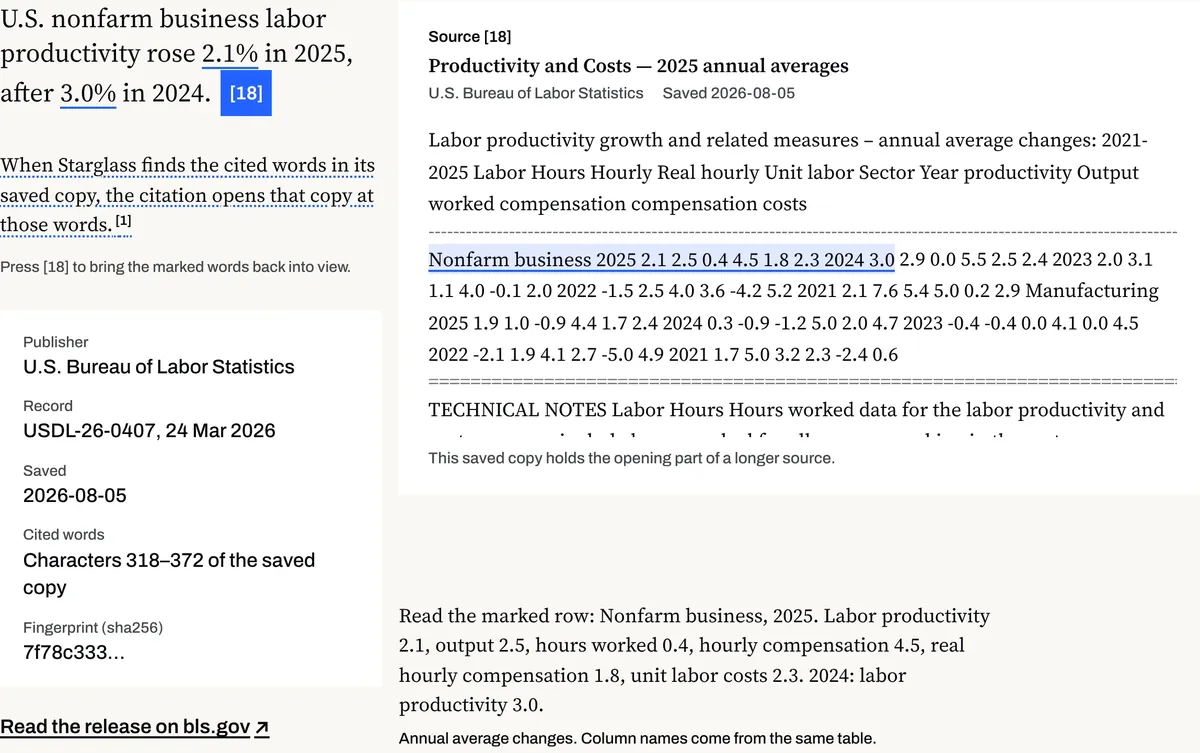
U.S. nonfarm business labor productivity rose 2.1% in 2025, after 3.0% in 2024. [18]
Show the cited wordsAn example Case, not a customer's.
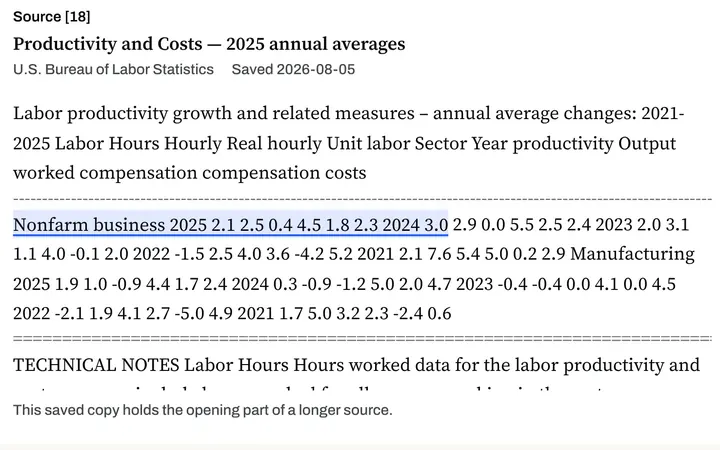
Source [18]
Productivity and Costs — 2025 annual averages
Labor productivity growth and related measures – annual average changes: 2021-2025 Labor Hours Hourly Real hourly Unit labor Sector Year productivity Output worked compensation compensation costs Nonfarm business 2025 2.1 2.5 0.4 4.5 1.8 2.3 2024 3.0 2.9 0.0 5.5 2.5 2.4 2023 2.0 3.1 1.1 4.0 -0.1 2.0 2022 -1.5 2.5 4.0 3.6 -4.2 5.2 2021 2.1 7.6 5.4 5.0 0.2 2.9 Manufacturing 2025 1.9 1.0 -0.9 4.4 1.7 2.4 2024 0.3 -0.9 -1.2 5.0 2.0 4.7 2023 -0.4 -0.4 0.0 4.1 0.0 4.5 2022 -2.1 1.9 4.1 2.7 -5.0 4.9 2021 1.7 5.0 3.2 2.3 -2.4 0.6 TECHNICAL NOTES Labor Hours Hours worked data for the labor productivity and cost measures include hours worked for all persons working in the sector—wage and salary workers, the self-employed and unpaid family workers. The primary source of hours and employment data is the BLS Current Employment Statistics (CES) program, which provides monthly survey data on the number of jobs held by and hours paid to wage and salary workers in nonfarm establishments, counting a person who is employed by two or more establishments at each place of employment. As of the February 3, 2023 Employment Situation release, the CES program has updated the national nonfarm payroll series to the 2022 North American Industry Classification System (NAICS). The BLS Major Sector Productivity program will be remaining on a NAICS 2017 basis for the time being by converting NAICS 2022 data from CES back to a NAICS 2017 basis using ratios published on the CES website and based on the Quarterly Census of Employment and Wages (QCEW). Hours of paid time off are removed from hours paid using data from the National Compensation Survey (NCS) for 1996 forward and data from the BLS Hours at Work survey, conducted for this purpose, prior to 1990. Between 1990 and 1995, hours of paid time off are removed using a combination of NCS and Hours at Work survey data. Off-the-clock hours are added, yielding hours worked, using data from the Current Population Survey (CPS). Data from the CPS are used to estimate hours worked for farm labor, nonfarm proprietors, and nonfarm unpaid family workers. Using CPS information on employment and hours worked at primary jobs and all other jobs, separately, the BLS productivity measures assign all hours worked to the appropriate industrial sector. Hours for government enterprises are derived from the CPS, the CES, and the National Income and Product Accounts (NIPA) prepared by the Bureau of Economic Analysis (BEA) of the Department of Commerce.
This saved copy holds the opening part of a longer source.
Read the marked row: Nonfarm business, 2025. Labor productivity 2.1, output 2.5, hours worked 0.4, hourly compensation 4.5, real hourly compensation 1.8, unit labor costs 2.3. 2024: labor productivity 3.0.
Annual average changes. Column names come from the same table.